
Japan Faces Growing Dementia Crisis: Can Technology Provide Relief?
Tokyo, 8 December 2025 – Japan is confronting an escalating dementia crisis that poses significant social and healthcare challenges to the nation. With its rapidly aging population, the country is turning to innovative technologies, including robotics and artificial intelligence (AI), in an effort to alleviate the pressure on caregivers and health services.
Rising Numbers and Alarming Trends
Last year, more than 18,000 elderly individuals living with dementia went missing across Japan, with almost 500 later found deceased. Police report that such cases have doubled since 2012, highlighting the urgent need to address the safety and wellbeing of this vulnerable group. Currently, nearly 30% of Japan’s population is aged 65 or older—the world’s second highest proportion after Monaco—according to the World Bank. This demographic shift strains the country’s healthcare infrastructure and workforce, especially as the pool of care workers shrinks and immigration limits restrict foreign labor inflows.
Government Response and Economic Impact
Recognizing dementia as a critical policy issue, the Japanese government has declared it a national priority. The Ministry of Health estimates dementia-related health and social care costs will surge from 9 trillion yen in 2025 to 14 trillion yen (approximately $90 billion) by 2030. To confront this looming burden, policymakers are pursuing technology-driven solutions to both enhance care and improve early detection.
Technological Innovations Supporting Dementia Care
Across Japan, GPS tracking systems are increasingly adopted to prevent and rapidly respond to instances of elderly individuals going missing. Some localities provide wearable GPS tags that automatically alert authorities if their wearer leaves designated areas. In certain communities, convenience store employees receive real-time notifications to activate a grassroots safety network capable of locating missing persons within hours.
Early detection is another focal point. Fujitsu and Acer Medical have developed “aiGait,” an AI-powered system that analyzes a person’s walking patterns and posture to identify early signs of dementia. By capturing motion data such as shuffling gait or difficulties in turning, aiGait generates detailed skeletal outlines for clinicians to review during routine health check-ups. “Early detection of age-related diseases is key,” says Hidenori Fujiwara, Fujitsu’s spokesperson. “If doctors can use motion-capture data, they can intervene earlier and help people remain active for longer.”
Robotic Caregivers and Emotional Support Devices
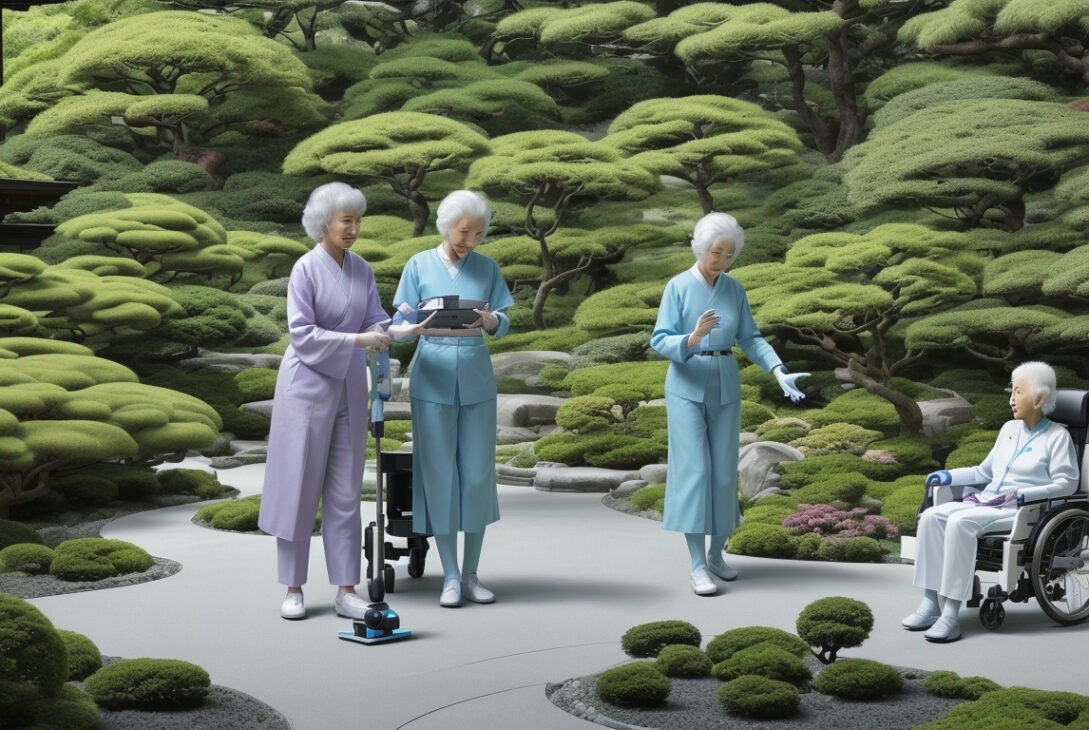
In Tokyo, researchers at Waseda University are advancing humanoid robot technology, exemplified by “AIREC,” a 150-kilogram robot designed as a future caregiver. AIREC can assist with everyday tasks such as helping individuals put on socks, scramble eggs, or fold laundry. The team envisions future iterations capable of changing adult nappies and preventing bedsores. While robots are currently deployed in care homes to entertain residents with music, facilitate stretching exercises, and monitor patients at night through sensors placed under mattresses, more complex interactions require further development. Assistant Professor Tamon Miyake predicts that it will take at least five years before robots can safely perform full-body sensing and adaptive responses necessary for nuanced caregiving.
Besides practical assistance, emotional support is a growing area of innovation. Sharp’s “Poketomo” is a small 12cm robot that users can carry in a bag or pocket. Poketomo provides medication reminders, weather updates, and conversational companionship aimed at reducing social isolation for those living alone. “We’re focusing on social issues and using new technology to help solve those problems,” states Miho Kagei, development manager at Sharp.
Human Connection Remains Essential
Despite the promise of technology, experts emphasize that robots should augment rather than replace human caregivers. “While robots may take over some tasks, their main role is to assist both caregivers and patients,” explains Assistant Professor Miyake. The importance of meaningful human interaction is vividly illustrated at the Restaurant of Mistaken Orders in Sengawa, Tokyo, founded by Akiko Kanna. The café employs people living with dementia, providing them with purposeful engagement and social interaction inspired by Kanna’s personal experience with her father’s condition.
At the café, servers like Toshio Morita maintain roles that encourage cognitive activity—he uses flowers to remember customer orders. Morita values the social environment, saying, “Honestly? I wanted a little pocket money. I like meeting all sorts of people. Everyone’s different—that’s what makes it fun.” Such community initiatives demonstrate that while technology offers valuable tools, sustaining quality of life for people with dementia depends on human empathy and connection.
Looking Ahead
Japan’s dementia crisis is a wake-up call for aging societies worldwide. By combining cutting-edge technology with compassionate community support, the country aims to create a sustainable model that addresses both the practical and emotional needs of those affected. As innovations continue to evolve, balancing robotic assistance with human care will be crucial for improving outcomes and easing the heavy burden dementia places on individuals, families, and society.
For continued updates on technology innovations and health news, subscribe to the BBC’s Tech Decoded newsletter.